
Boost Your Access Security: Expert Insights
In an increasingly interconnected digital landscape, access security has become one of the most critical pillars of organizational cybersecurity strategy. Whether you’re protecting sensitive company data, financial records, or personal information, controlling who gets access to what resources is fundamental to preventing breaches, insider threats, and unauthorized data exposure. Modern threats have evolved far beyond simple password attacks—today’s adversaries employ sophisticated techniques including credential stuffing, privilege escalation, and lateral movement to compromise systems and steal valuable assets.
Access security encompasses a comprehensive approach to identity verification, authentication, authorization, and ongoing monitoring of user activities across digital environments. It’s not merely about locking doors; it’s about creating layered defenses that verify every identity, validate every request, and track every action. Organizations that implement robust access security frameworks significantly reduce their attack surface and demonstrate a commitment to data protection that builds stakeholder trust and ensures regulatory compliance.
This expert guide explores cutting-edge strategies, proven methodologies, and actionable insights from leading security professionals to help you strengthen your access security posture and defend against evolving threats.

Understanding Access Security Fundamentals
Access security represents the systematic approach to controlling, managing, and monitoring user access to systems, applications, and data resources. At its core, it answers three fundamental questions: Who are you? (authentication), What are you allowed to do? (authorization), and What did you actually do? (accountability). These three pillars form the foundation upon which all effective access security programs are built.
The authentication layer verifies that users are genuinely who they claim to be through various mechanisms ranging from passwords to biometric identifiers. Authorization determines what authenticated users can access based on their role, department, project involvement, and security clearance level. Accountability ensures that all access attempts and activities are logged, monitored, and auditable for compliance and forensic investigation purposes.
Modern organizations face unprecedented challenges in managing access across hybrid environments that include on-premises data centers, cloud platforms, SaaS applications, and remote work infrastructure. Each access point represents a potential vulnerability if not properly secured. According to CISA (Cybersecurity and Infrastructure Security Agency), weak or compromised credentials remain one of the top initial compromise vectors used by attackers. This reality underscores why access security must be treated as a strategic priority rather than a technical afterthought.
The consequences of inadequate access security extend beyond immediate data breaches. Regulatory penalties under frameworks like GDPR, HIPAA, and CCPA can reach millions of dollars. Reputational damage from publicized breaches erodes customer trust and competitive positioning. Business disruption from ransomware attacks that exploit weak access controls can halt operations for weeks or months. These risks make investment in access security not just a compliance obligation but a business imperative.
Multi-Factor Authentication: The Foundation of Modern Access Control
Multi-factor authentication (MFA) represents the single most effective control for preventing unauthorized access, even when passwords are compromised. By requiring users to provide two or more verification factors, MFA creates a substantial barrier against credential-based attacks that have plagued organizations for decades. The three primary authentication factors are: something you know (passwords, PINs), something you have (security keys, mobile devices, smart cards), and something you are (fingerprints, facial recognition, iris scans).
Password-only authentication has become functionally obsolete in security-conscious organizations. Attackers can obtain passwords through phishing attacks, data breaches, malware infections, and credential stuffing—often with minimal effort. Even strong, unique passwords provide false confidence when users are tricked into revealing them or when systems storing password hashes are compromised. MFA fundamentally changes the threat calculus by ensuring that stolen credentials alone cannot grant access.
The most secure MFA implementations use hardware security keys based on FIDO2 standards, which provide phishing-resistant authentication that cannot be intercepted or replayed by attackers. These physical keys—similar to USB dongles—authenticate through cryptographic protocols that verify both the legitimate service and the user’s identity. NIST SP 800-63B guidelines recommend hardware keys as the strongest authentication method for high-value accounts and sensitive systems.
Time-based one-time passwords (TOTP) generated by authenticator applications provide a practical middle ground between security and usability. Apps like Google Authenticator, Microsoft Authenticator, and Authy generate time-synchronized codes that change every 30 seconds, making them immune to credential stuffing but still vulnerable to certain attack vectors. SMS-based authentication, while better than passwords alone, should be considered a minimum baseline rather than best practice due to vulnerabilities in cellular networks and SIM swapping attacks.
Push-based authentication, where users receive notifications on trusted devices and must approve access requests, combines convenience with security by leveraging something the user has (their device) and something they know (ability to recognize legitimate requests). This approach reduces friction compared to hardware keys while maintaining strong security posture.
Zero Trust Architecture and Continuous Verification
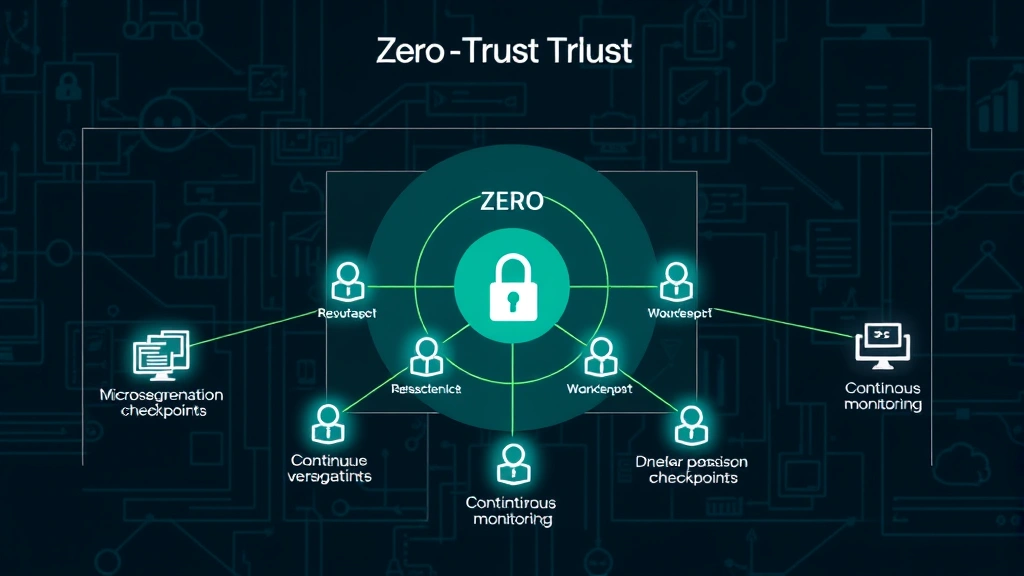
Zero Trust represents a fundamental paradigm shift from the outdated “trust but verify” model that assumed internal networks were inherently safe. Instead, Zero Trust operates on the principle of “never trust, always verify”—every access request, regardless of origin or user status, must be authenticated, authorized, and continuously verified before and after resource access is granted.
Traditional network security relied on perimeter defenses—firewalls and VPNs that created a hard outer shell protecting everything inside. This approach fails catastrophically in modern environments where employees work remotely, contractors access systems, cloud resources exist outside corporate networks, and attackers have become skilled at lateral movement once they breach the perimeter.
Zero Trust architecture implements several key principles: verify every identity through strong authentication; validate every device for security compliance; enforce least privilege access; monitor all network traffic; encrypt all communications; and assume breach mentality in all designs. This comprehensive approach requires integration of identity and access management systems with network security, endpoint protection, and continuous monitoring platforms.
Implementation requires deploying software-defined perimeters, also called Microsegmentation, which restricts lateral movement by creating granular access boundaries around applications and data. Rather than granting broad network access to all internal systems, Zero Trust ensures users can only access specific resources they need for their role. If an attacker compromises one account, the damage is limited by these segmentation boundaries.
Contextual access policies represent another critical Zero Trust component. Access decisions incorporate not just identity verification but also device health status, network location, time of day, user behavior patterns, and risk scores. An employee requesting access from their corporate device on the company network at normal business hours receives different trust levels than the same employee requesting access from an unknown location on an unmanaged device at 3 AM.
Identity and Access Management Best Practices
Effective identity and access management (IAM) systems serve as the central nervous system for access security, coordinating authentication, authorization, and provisioning across all organizational resources. Comprehensive IAM programs establish authoritative sources of identity information, automate access provisioning based on role definitions, and enforce consistent policies across hybrid environments.
The IAM lifecycle begins with identity provisioning—the process of creating user accounts, assigning roles, and granting appropriate access when employees join organizations or transition between roles. Automated provisioning systems that integrate with HR systems reduce manual errors and ensure timely access grants. However, provisioning speed must be balanced against security verification to prevent granting access to unauthorized individuals.
Access reviews represent a critical IAM control often overlooked in practice. Quarterly or semi-annual reviews where managers certify that direct reports retain appropriate access levels identify unnecessary access, stale accounts, and potential policy violations. These reviews create accountability and ensure that access rights remain aligned with current job responsibilities rather than accumulating permissions over years of role changes.
Account deprovisioning—removing access when employees depart or change roles—must occur swiftly and comprehensively. Organizations frequently discover that terminated employees retain access to critical systems months or years after departure, creating significant security risks. Automated deprovisioning workflows that trigger from HR system termination records ensure timely removal across all connected systems.
Role-based access control (RBAC) simplifies access management by grouping users with similar job functions into roles with predefined permissions. Rather than managing individual user permissions, administrators manage role definitions and assign users to roles. This approach scales effectively as organizations grow and reduces the complexity of access decisions. However, RBAC must be paired with regular role reviews to prevent role creep where permissions accumulate beyond their original intent.
Attribute-based access control (ABAC) provides more granular control by making access decisions based on user attributes (department, location, clearance level), resource attributes (data classification, system sensitivity), and environmental attributes (time, network location, device type). ABAC requires more sophisticated policy engines but enables more precise least privilege implementation.
Privilege Management and Least Privilege Principles
Privileged access represents the highest-value target for attackers because it grants control over systems, data, and security controls themselves. Compromised privileged accounts enable attackers to install malware, exfiltrate data, modify security logs, and establish persistent backdoors. Organizations must implement specialized controls for privileged accounts that exceed protections applied to standard user accounts.
The principle of least privilege mandates that users receive only the minimum access necessary to perform their job functions. This principle applies across all access levels—standard users should not have administrative rights, administrators should not have unrestricted access to all systems, and service accounts should have access limited to specific functions. Least privilege dramatically reduces damage potential when accounts are compromised because attackers inherit only limited permissions.
Privileged access management (PAM) solutions provide centralized management of privileged accounts, credentials, and sessions. These platforms store sensitive credentials in encrypted vaults, automatically rotate passwords, record and monitor privileged sessions, and enforce multi-factor authentication for privileged access. PAM solutions prevent administrators from knowing actual passwords—instead, they request temporary access through the PAM system, which verifies their identity and logs all actions.
Just-in-time (JIT) access provisioning elevates least privilege by granting privileged access only when needed and for limited durations. Rather than maintaining standing administrative privileges, users request temporary elevation through the PAM system, which automatically revokes access after the specified time window expires. This approach eliminates persistent administrative privileges that could be exploited during unattended sessions.
Session recording and monitoring of privileged activities creates accountability and enables detection of suspicious behavior. When administrators know their privileged sessions are recorded, it deters unauthorized actions and provides forensic evidence if incidents occur. Advanced PAM solutions use behavioral analytics to detect anomalous privileged activities that might indicate account compromise.
Monitoring, Detection, and Incident Response
Access security monitoring and detection systems transform access logs into actionable intelligence that identifies compromise attempts, policy violations, and suspicious behavior patterns. These systems aggregate access logs from multiple sources—authentication systems, directory services, cloud platforms, applications—and apply analytics to detect threats that would be invisible in raw log files.
User and entity behavior analytics (UEBA) establishes baseline behavior patterns for users and systems, then alerts when activities deviate significantly from established patterns. An employee who typically accesses files during business hours from their office suddenly accessing large volumes of sensitive data from a foreign country at midnight represents a significant anomaly warranting investigation. UEBA reduces false positives by focusing on meaningful deviations rather than every access attempt.
Impossible travel detection identifies when users access resources from geographically distant locations in timeframes that would require faster-than-possible travel. An employee accessing systems in New York at 2 PM and Los Angeles at 3 PM indicates either account compromise or stolen credentials, prompting immediate investigation and access revocation.
Failed authentication monitoring reveals brute force attacks, credential stuffing attempts, and account enumeration. Spikes in failed login attempts targeting specific accounts or services warrant immediate investigation and potential remediation such as temporary account lockdowns or IP blocking.
Incident response procedures must be pre-planned and regularly tested to enable rapid response when suspicious access activities are detected. Incident response teams need clear escalation procedures, communication protocols, and decision criteria for actions such as account lockdown, session termination, and credential revocation. According to Mandiant threat intelligence research, organizations with practiced incident response procedures containing breach dwell time—the period between initial compromise and detection—to an average of 21 days compared to 200+ days for organizations without formal procedures.
Forensic investigation capabilities enable detailed reconstruction of attacker activities following incidents. Organizations should maintain detailed access logs with sufficient retention periods (minimum 1 year, preferably longer) to support thorough investigations. Immutable logging systems that prevent tampering with audit records ensure investigation integrity.
Compliance Frameworks and Regulatory Requirements
Multiple regulatory frameworks mandate specific access security controls and practices. Understanding applicable requirements ensures compliance while building security programs that meet both regulatory and business needs. While regulatory compliance alone should not be the sole driver of security investment, alignment with established frameworks provides validation that security programs address known risks effectively.
The General Data Protection Regulation (GDPR) requires organizations to implement technical and organizational measures to protect personal data, including access controls that ensure only authorized personnel can access personal information. GDPR’s accountability principle requires organizations to document and demonstrate compliance through access control policies, regular reviews, and incident documentation.
The Health Insurance Portability and Accountability Act (HIPAA) mandates access controls for protected health information, including unique user identification, emergency access procedures, and automatic logoff. HIPAA’s audit controls requirement demands comprehensive logging and monitoring of access to electronic health records.
The Payment Card Industry Data Security Standard (PCI DSS) requires multi-factor authentication for remote access to cardholder data environments, role-based access control, regular access reviews, and immediate removal of access for terminated employees. PCI DSS compliance demonstrates commitment to payment security that reassures customers and payment processors.
The NIST SP 800-171 security requirements guide government contractors and federal agencies in protecting controlled unclassified information. These requirements include strong authentication, access control policies, privileged access management, and continuous monitoring—providing a comprehensive security framework applicable beyond federal contexts.
The Sarbanes-Oxley Act (SOX) requires public companies to implement access controls preventing unauthorized modification of financial records and audit logs. SOX compliance requires segregation of duties where no single individual can both authorize and record transactions, enforced through access control systems.
California Consumer Privacy Act (CCPA) requires organizations to implement reasonable security measures protecting consumer personal information, including access controls limiting employee access to personal information to business-necessary purposes. CCPA’s consumer rights provisions require organizations to verify requestor identity before disclosing personal information, necessitating robust authentication procedures.
FAQ
What is the most important aspect of access security?
Authentication—verifying user identity—represents the foundation of access security. If you cannot reliably verify who is requesting access, all subsequent authorization decisions are compromised. Strong authentication through multi-factor methods prevents the majority of unauthorized access attempts that exploit weak or stolen credentials.
How often should access reviews be conducted?
Organizations should conduct comprehensive access reviews at minimum quarterly, with more frequent reviews for privileged accounts and sensitive systems. Annual reviews are insufficient given the frequency of role changes and organizational restructuring in most enterprises. Monthly reviews of privileged access provide optimal security for highest-risk accounts.
Can passwords alone provide adequate access security?
No. Passwords alone cannot provide adequate access security in modern threat environments. Attackers can compromise passwords through phishing, malware, data breaches, and brute force attacks. Multi-factor authentication should be considered mandatory for all accounts, with hardware security keys recommended for sensitive and privileged accounts.
What is the difference between authentication and authorization?
Authentication verifies that users are who they claim to be through identity verification mechanisms. Authorization determines what authenticated users are permitted to access based on their roles, responsibilities, and security clearance. Both are essential—strong authentication without proper authorization still enables excessive access, while strong authorization without reliable authentication allows unauthorized individuals to gain access.
How should organizations handle privileged account passwords?
Organizations should never store privileged account passwords in standard password managers or shared documents. Instead, implement dedicated privileged access management (PAM) solutions that store passwords in encrypted vaults, automatically rotate credentials, enforce multi-factor authentication, and log all access. PAM solutions ensure administrators cannot access actual passwords while maintaining the ability to request temporary privileged access.
What role does monitoring play in access security?
Monitoring and detection systems transform access logs into actionable intelligence that identifies compromise attempts and suspicious behavior. Without monitoring, organizations cannot detect when compromised accounts are actively being exploited. User and entity behavior analytics (UEBA) applies advanced analytics to detect anomalies that indicate account compromise or insider threats that would be invisible in raw logs.


